
Why 55% of Deep Tech Companies Fail: The Communication Problem No One Talks About | Hailey Eustace
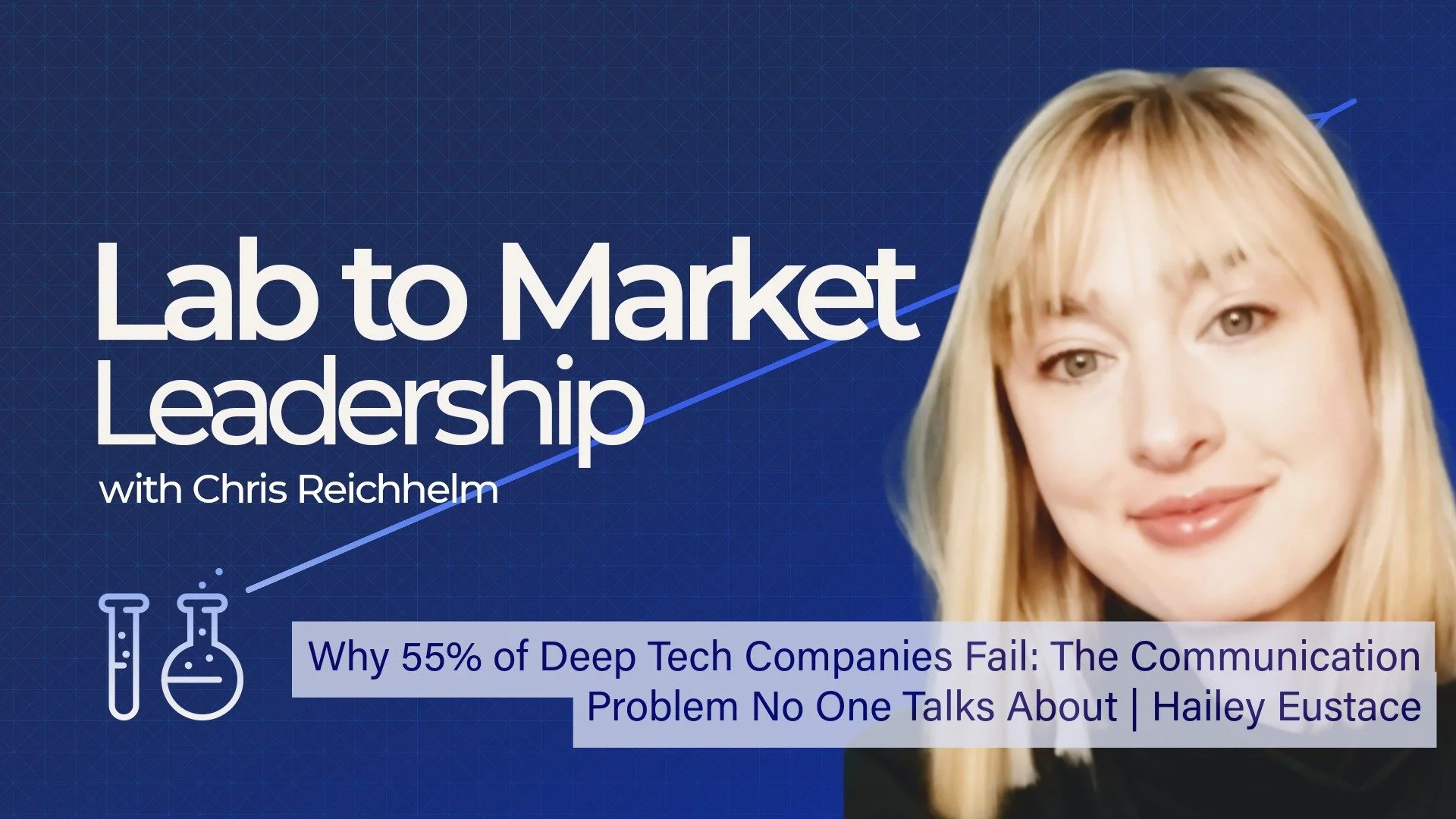
Hailey Eustace | Founder and CEO, Commplicated
Podcast Episode Description:
More than half of all Deep Tech companies fail within five years. The reasons are well-documented: lack of product-market fit, funding constraints, poor management, weak business models, difficult product engineering, misaligned timing, external factors, strategic errors, and competition.
Strip away the 'difficult product engineering' category, and what do the remaining failure modes have in common? Communication.
Hailey Eustace, founder and CEO of Commplicated, has spent her career at this intersection. As an analyst at the Texas Emerging Technology Fund, a $500 million Deep Tech seed fund that invested in SpaceX, she reviewed hundreds of Deep Tech pitches. Time and again, she saw the same pattern: 12 slides explaining a molecule, zero slides explaining who the first customers would be or how big the company could become.
Brilliant founders with breakthrough technology lost millions because they couldn't give investors the language to talk about them when they weren't in the room. They couldn't translate their science into compelling business narratives. They treated communications as an afterthought rather than fundamental strategy.
After founding Commplicated in 2023, Hailey now helps technical founders articulate their visions and achieve critical business and funding milestones through fractional CMO services, business advisory, and strategic branding. Alongside running Commplicated, she's an active angel investor in early-stage Deep Tech, serves as Venture Scout at Ada Ventures, and mentors founders through Founders at the University of Cambridge and Deeptech Labs. This combination of investor, advisor, and communications expert gives her rare insight into what actually works—and why communication failures destroy companies:
Product-market fit is a communication problem. It's not just about building what the market needs - it's about listening, comprehending, translating that understanding into your work, and communicating back to the market in a language they recognise. The feedback loop is communication.
Fundraising is a communication problem. You need to give very intelligent people the right language to talk about your company when you're not in the room. That balance between technical substance and accessible narrative is extraordinarily difficult, but essential.
Winning customers and partners is a communication problem. Trust breaks down when your words don't align with your actions, when you promise what you can't deliver, or when you can't articulate why your 80% solution today matters more than a perfect solution in five years.
Building teams and culture is a communication problem. Recruiting exceptional people, turning them into cohesive high-performing units, maintaining alignment as you scale—all fundamentally about communication.
Hailey's observations reveal stark differences between American and European founders. Americans allocate 20%+ of their budget to marketing, branding, and PR. Europeans resist. Americans want to own their market by Series A - going 'blitzscale' about domination. Europeans wait for their companies to develop 'like fine wine'.
But markets don't reward patience anymore. Deep Tech operates on different timescales than software, yes, you need to think in five or ten-year horizons for technologies like autonomous vehicles, where people will literally trust these systems with their lives. But within that long-term view, you still need to move with urgency.
The companies doing communications brilliantly understand this. Wayve takes the science seriously, brings key opinion leaders along on the journey, attracts exceptional talent, and raised £1 billion from SoftBank and Nvidia by telling that story compellingly. Nvidia approaches communications strategically - it runs through everything they do. Their Inception programme wasn't 'cosplaying caring about startups' - it was genuine relationship building that turned early-stage AI companies into customers as they scaled.
Hailey's process starts with the core message. Not different messages for different audiences, but one foundational message everyone shares. Investors, customers, team members - they can focus on different aspects ('different rooms of the same house'), but they need the same shared understanding of what the company does and why it matters.
That core message requires brutal discipline to maintain. It can't be 'just say whatever comes into our heads'. Scientific founders often resist this initially - they think the science speaks for itself, that communications is fluffy. But once they see the results, they become the biggest supporters. They realise that explaining complex science simply isn't dumbing it down - it's the hardest intellectual work there is.
Hailey's starting point for any founder struggling with communications: Define your one thing for 2026. What's the single message you want everyone to know about your company this year?. Not five things. One thing. Build from there.
This isn't about becoming a marketing expert overnight. It's about recognising that communications is strategy. It's product. It's team. It's everything. And treating it with the same rigour you bring to your science could be the difference between the 55% that fails and the 45% that survives.
For Deep Tech founders who've spent years perfecting their technology only to struggle with translation, this conversation offers essential perspective. The work doesn't end when the science succeeds. In many ways, it's just beginning.
Show Notes:
00:00 Starting with Your Core Message
01:10 Introduction to the Podcast
01:44 Deep Tech Failure Rates and Reasons
03:26 The Importance of Communication
04:49 Interview with Haley Eustace
06:06 Challenges in Deep Tech Communication
07:15 The Role of Investors and Board Members
08:15 Developing a Communication Strategy
19:54 The Journey from Investment to Communication
28:34 The Importance of a Unified Core Message
29:44 Challenges in Consistent Messaging
30:41 Discipline and Communication in Startups
32:58 Cultural Differences in Communication Strategies
36:51 The Role of Confidence and Speed in Success
39:12 Effective Communication in Deep Tech
46:26 Personal Aspects of Communication Roles
51:34 Starting with a Core Message
53:41 Conclusion and Final Thoughts
Subscribe to our technology leadership podcast on YouTube or wherever you get your podcasts to stay updated on the latest insights from Deep Tech innovators.
To learn more about Lab-to-Market Leadership, view our presentation: ‘The Lab-to-Market Journey – a Blueprint.’
Additionally, learn about our work with Chief Executive Officers.
This episode of the Lab to Market Leadership podcast was produced by Beauxhaus.
