
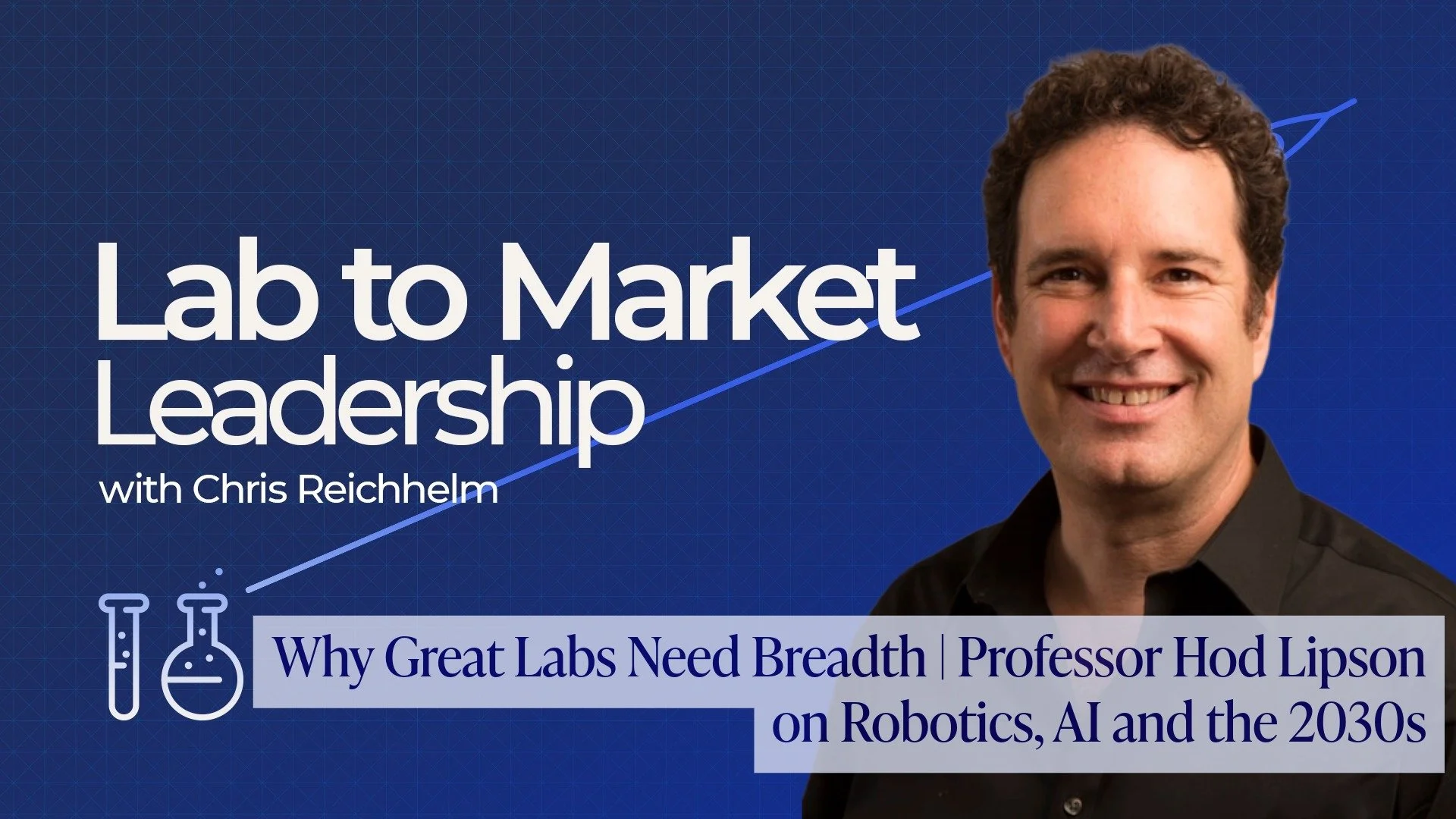
What if the best Deep Tech labs are not built around expertise, but around creative range?
Professor Hod Lipson is one of the world’s leading robotics researchers. His Creative Machines Lab at Columbia University – recently profiled in depth by the Financial Times – has become a reference point for how serious research institutions can generate breakthroughs, founders and ideas at the same time.
In this episode, he explains how the Creative Machines Lab became an innovation engine, why he deliberately resisted the conventional ‘focus, focus, focus’ model, and why robotics – not just AI – is where the next major breakthrough may happen. He also outlines why he believes the 2030s may be the decade when physical intelligence begins to scale.
Breadth over focus
Hod argues that over-specialisation can narrow ambition, reduce collaboration and create echo chambers. By contrast, broader labs can attract more funding, more students and more cross-disciplinary ideas. His own experience suggests that diversity of topic can create a healthier, more productive research culture.
Portfolio over grades
When Hod recruits, he looks for evidence of creative output. He does not place much value on grades or reference letters. Instead, he searches for a portfolio of work that demonstrates initiative, originality and the ability to do something genuinely interesting with the tools available.
The licence to explore
For Hod, academia’s real gift is freedom from quarterly targets and short-term profit pressures. That licence creates an obligation: to work on the kinds of long-horizon problems that industry cannot justify. In his view, that is where universities can make their most important contribution.
The 2030s
Hod believes AI has largely established its path, while robotics and physical intelligence remain much earlier in their development. He sees this as the next major frontier in Deep Tech, and thinks the coming decade may be defined by breakthroughs in the way machines interact with the physical world.
Chapter Notes:
00:00 Virtual AI to Robotics
01:16 Podcast Mission Intro
02:59 Meet Hod Lipson
04:15 Financial Times Spotlight
05:56 First Startup Lessons
07:53 Quest for Intelligence
09:55 Creative Machines Lab Purpose
14:38 Generalist Over Focus
17:54 Impact as the Metric
20:26 Academia’s License to Explore
22:55 Hiring by Portfolio
28:12 Lab Admissions and Self Drive
29:06 Earning Advisor Attention
30:06 Idea List to Real Projects
32:43 Diversity Beats Echo Chambers
36:25 Darwinian Lab Competition
38:29 Gut Feel Time Horizons
41:30 Origins and Early Influences
46:04 Mentors and Impact Lessons
49:08 Biggest Research Contributions
52:59 Robotics Boom in 2030s
56:47 Self Confidence Closing
Subscribe to our technology leadership podcast on YouTube or wherever you get your podcasts to stay updated on the latest insights from Deep Tech innovators.
To learn more about Lab-to-Market Leadership, view our presentation: ‘The Lab-to-Market Journey – a Blueprint.’
Additionally, learn about our work with Chief Executive Officers.
This episode of the Lab to Market Leadership podcast was produced by Beauxhaus.
