
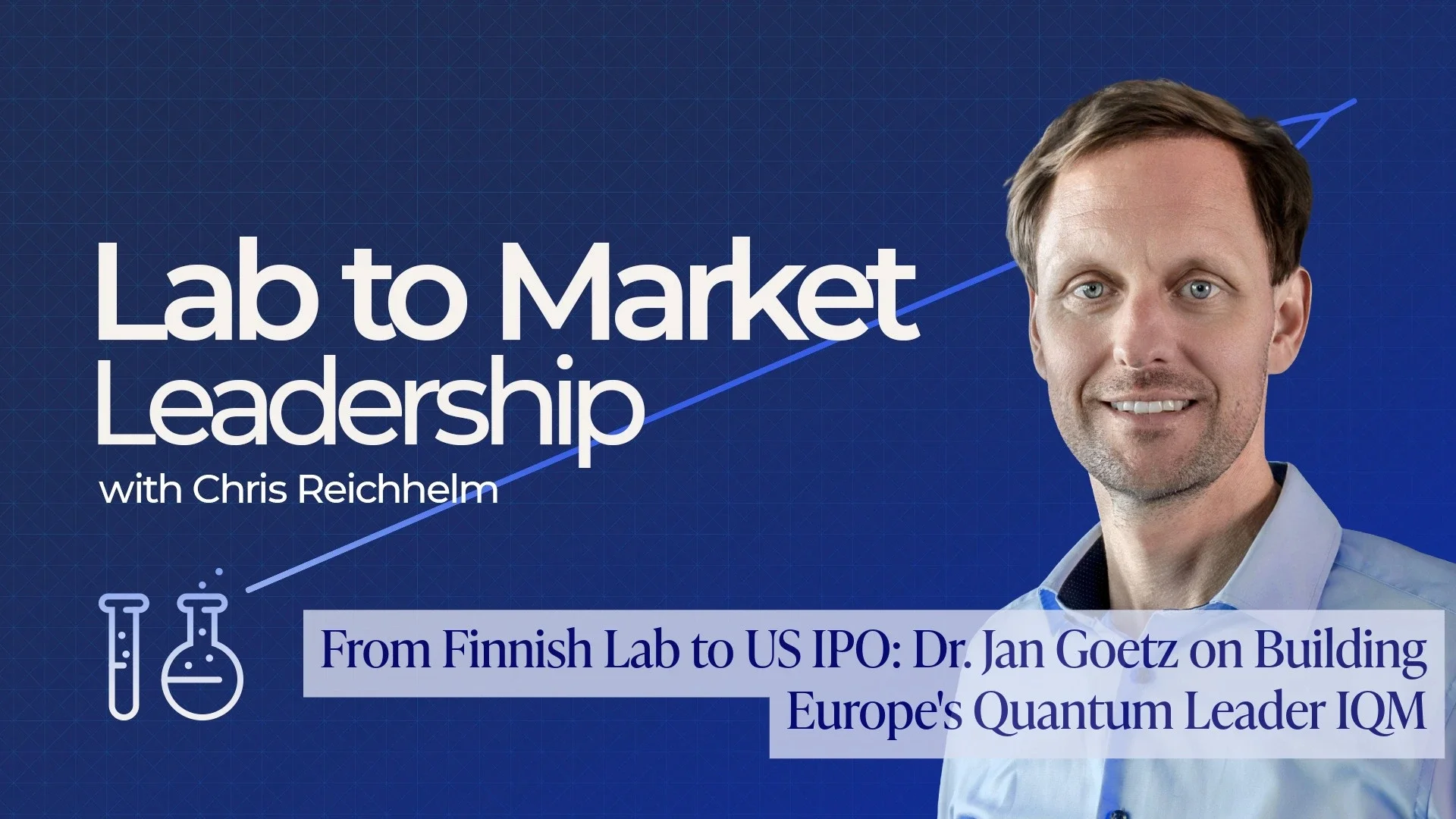
From Finnish Lab to US IPO: Dr Jan Goetz on Building Europe's Quantum Leader IQM
Podcast Episode Description:
Dr. Jan Goetz never planned to be a CEO. He wanted to be a professor, working with students, driving science forward. Seven years ago, he was a postdoc researcher at Aalto University in Finland.
Then his co-founder Professor Mikko Möttönen asked what he thought about starting a company.
Jan followed his gut. Today, IQM is Europe's largest quantum computing company, heading towards US public listing later this year, and just secured €50M financing from BlackRock.
This is a rare, personal look at the founder CEO journey – not just the company wins, but the internal transitions, the moments of doubt, and how Jan learned to lead whilst staying true to himself.
The co-founding team
IQM incorporated in April 2018, spinning out of VTT and Aalto University. Four co-founders divided roles based on strengths:
Dr. Mikko Möttönen stayed in academia as a professor, creating a talent pipeline and collaboration opportunities. Dr. Kuan Yen Tan became CTO, bringing the deepest technology expertise (he was initially in Australia). Dr. Juha Vartiainen became COO with operational experience from industry. Dr. Jan Goetz became CEO, focusing on storytelling and vision. He describes himself as the ‘foreign minister’ of the company.
Early strategic decision: sell chips or complete quantum computers? Initially, they thought both. But they quickly realised nobody would integrate the chips – the industry was too early, no system integrators existed. They stopped the chip business entirely and focused on selling complete quantum computers.
The SpaceX analogy that convinced governments
Who would buy quantum computers with no commercial applications yet?
Jan's team used SpaceX as the model. In the early days, SpaceX sold rocket flights to NASA and government organisations. Many rockets exploded right after launch. But governments bought them anyway – rightfully so, because that's how you build companies that can compete globally.
They pitched European governments: buy a 5-qubit machine first, then 20 qubits, scaling up from there.
IQM's own engineers questioned it. Why would anyone buy a 5-qubit machine?
Jan pushed through anyway. Sometimes, founders need to show strength even when people doubt them. They're still selling 5-qubit machines today as educational tools to universities.
Timing, agility and unexpected opportunities
Two unplanned developments shaped IQM's success:
Finland's EU presidency (July 2019) coincided exactly with IQM announcing seed funding. This placed them at prominent Brussels events, connecting them directly with Finnish government and EU decision-makers. This wasn't planned but helped enormously – being at the right places with the right people at the right time.
COVID rescue budgets followed. Governments created massive economic rescue programmes overnight. Germany's budget included building at least two quantum computers for €2B through procurement. This opened the door for IQM.
IQM's chip factory financing came from European Investment Bank's COVID programme. Founders can't plan these things. They just happen. What matters is being agile enough to see everything as an opportunity.
The founder CEO transition
Jan's role shifted dramatically from postdoc researcher to CEO storyteller. His strength was listening and learning different languages. Policy-makers use different language than scientists. He focused on listening, understanding, then repeating things back in their own words.
He remembers awkward early moments. Someone asked about the cap table. Jan didn't know what a cap table was. He'd never heard the term. So he said it looked great and was really nice. Then he learned.
His philosophy: understand your strengths and weaknesses. Put your strengths into play. Find others to cover your weaknesses. Don't waste time trying to do everything you're not good at.
The co-CEO period
Around 2021–2022, fundraising became difficult. Zero interest rates ended. Governments moved slowly buying systems. Tough decisions needed making. Jan's strength wasn't operational restructuring.
They brought in a co-CEO (Mikko Välimäki) to handle business and operations whilst Jan continued external work – investors, journalists, politicians, technology. On paper, it sounds easy. In reality, it's not straightforward. People play games, going to one person with one topic and another person with something else.
But it worked. They managed to bring the company to where it is today.
The vulnerable moment in Canada
Lying in bed in Canada on vacation, Jan realised he wasn't coping well. Small things were getting under his skin. He signed up for a marathon that day. Now he runs daily into the woods – no headphones, no phone, just him and his thoughts.
His most important job as CEO: prevent yourself from going down the spiral. When you're down there, you're not helpful at all. You might have every other task on your list, but you won't execute on any of them if you haven't made sure the number one task – staying mentally fit – is done.
Following your heart
When Jan chose Aalto over Barcelona or US East Coast opportunities, people told him he was crazy. Why go to Finland? But it felt right – the team, the ecosystem, the trust Mikko showed in him.
Sometimes you reach points where you have to decide. Do you follow your predefined plan or follow your heart? Sometimes they align. Sometimes they don't. Jan followed his gut feeling and doesn't regret it.
Preparing for public markets
IQM is heading towards dual listing on US and Helsinki stock exchanges later in 2026. Jan sees it as supporting the business, not just ringing the bell.
Public markets offer optionality for continuing to build full-stack quantum computers – an expensive endeavour. They also build trust with government customers. Being a public company means you're under much more scrutiny, which creates trust amongst key customers that you'll be there in the future.
The challenge: learning public company CEO language and being careful with forward-looking statements. As an early-stage founder, telling people what you're going to do is all you do. Now you're not allowed to do that anymore, at least not so much.
Today IQM employs 350+ people, is valued at $1.8B, leads globally in quantum computers sold, and with €50M BlackRock financing just announced, continues accelerating towards its vision of making quantum computing accessible worldwide.
For scientific founders navigating the transition to CEO, Jan's journey offers essential lessons in knowing your strengths, following your gut, seeing opportunities in challenges, and protecting your mental fitness whilst building the company.
Subscribe to our technology leadership podcast on YouTube or wherever you get your podcasts to stay updated on the latest insights from Deep Tech innovators.
To learn more about Lab-to-Market Leadership, view our presentation: ‘The Lab-to-Market Journey – a Blueprint.’
Additionally, learn about our work with Chief Executive Officers.
This episode of the Lab to Market Leadership podcast was produced by Beauxhaus.
