
Graphene at Scale: How Paragraf is Realising the Wonder Material’s Potential | Dr Simon Thomas
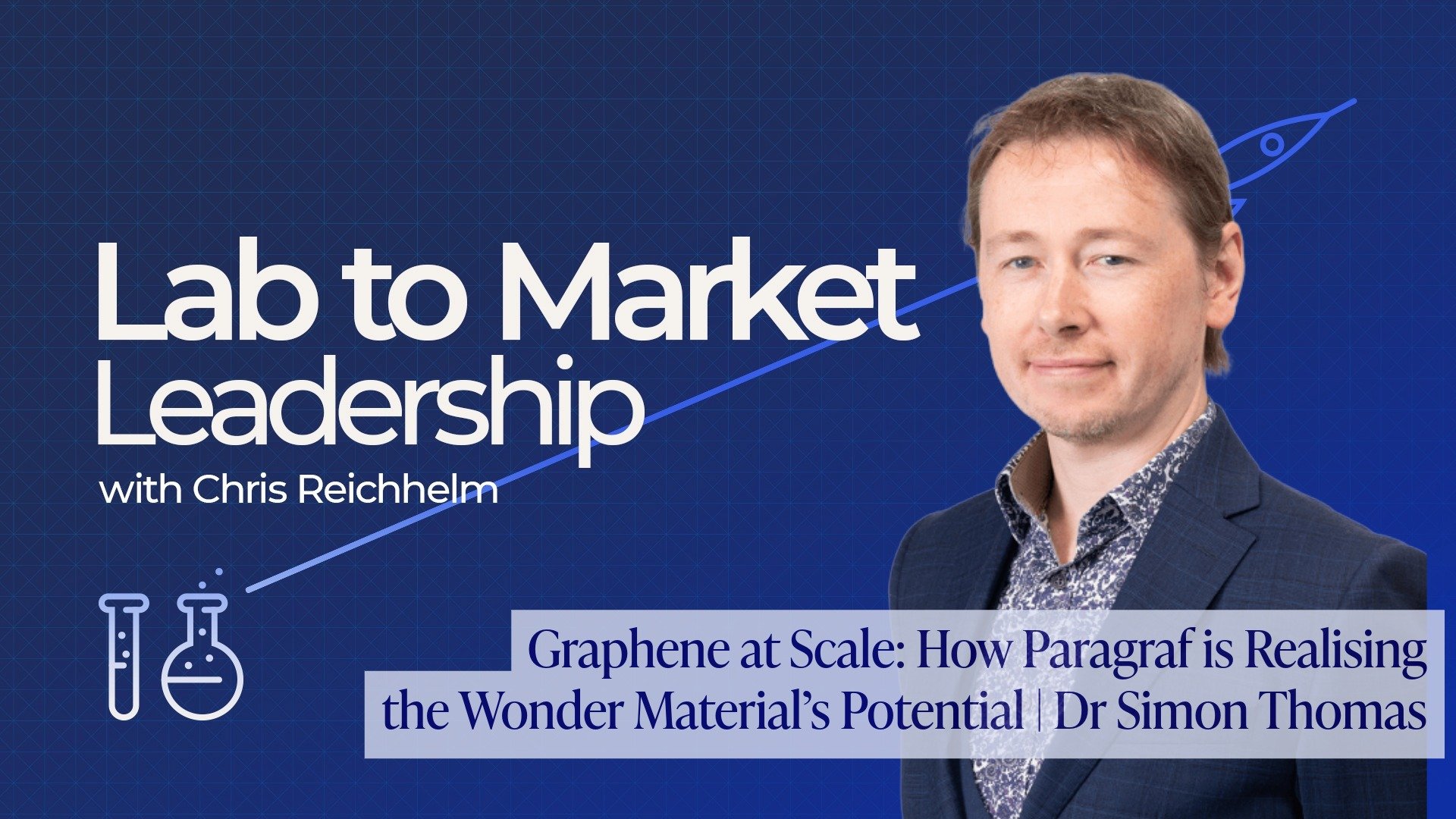
Podcast Episode Description:
Dr Simon Thomas never set out to run a company. After 12 years working inside the world’s largest semiconductor fabs – TSMC in Taiwan, Samsung and LG in South Korea – he was looking for a reset.
Instead, the University of Cambridge’s Professor Sir Colin Humphreys presented him with a problem that had defeated the industry for a decade: making graphene at wafer scale. Samsung had already burned more than $2.2 billion on the challenge. Intel had poured in close to $1 billion. Nobody had found a viable path.
Over five intense weeks of experiments, Simon tried applying compound‑semiconductor process thinking to graphene. The first result wasn’t perfect, but it was promising enough to show the theory might work. That early proof of concept set the trajectory for Paragraf. A short time later the company took shape; in December 2024, it brought the world’s first graphene electronics foundry online.
This episode of Lab to Market Leadership follows Simon’s journey from materials scientist and process engineer to founder and CEO – exploring not just the technical breakthrough, but the transitions, doubts and leadership shifts that came with it.
The experience that made the breakthrough possible
Simon’s route into graphene started with aerospace engineering at Liverpool, then a PhD in materials science that pulled him into gallium nitride and compound semiconductors. That expertise took him to TSMC, Samsung and LG, where he spent 12 years learning how the best fabs on the planet actually run – from materials and process development through to finished devices and end products.
When he moved back to the UK in 2015, Colin Humphreys persuaded him that joining his Cambridge group would be a different kind of challenge. On a train back from Manchester after a visit to the graphene team there, Colin posed the key question: could graphene be made at wafer scale using a different toolset?
Turning theory into manufacturable graphene
Most people saw graphene growth as a pure materials‑science problem. Simon approached it as a process‑engineering puzzle that lived in the gap between elegant theory and messy reality on the fab floor. Drawing on techniques from gallium nitride, Paragraf’s early work combined familiar semiconductor toolsets with a new way of thinking about graphene growth.
The first experimental run produced amorphous carbon with some graphene‑like features – not the end goal, but enough to justify pushing on. Six months of refinement followed to turn that hint into something repeatable and manufacturable. Without that initial positive signal, Simon says he probably would have stopped.
Climbing out of graphene’s trough of disillusionment
By 2015–2016, graphene’s reputation in industry was badly damaged. Years of hype around copper‑based growth methods had led to disappointing, inconsistent devices and a trail of failed companies. Investors and customers had good reason to be sceptical.
When Paragraf announced pristine graphene grown directly on the substrate, the first question was always: what makes this different from everything that failed before? Element maps and growth data helped, but they weren’t enough on their own. The team had to build real devices – Hall sensors, FETs and other components – that performed reliably outside the lab to demonstrate that this wasn’t just another materials story.
The South Korea meeting that showed how deep the distrust ran
A visit to South Korea brought the reality home. Meeting the CTO of one of the country’s two largest foundries, Simon was barely through introductions when the CTO opened with: ‘I just want to let you know that you are a liar.’
The CTO’s point was simple: his organisation had spent years and significant budget chasing wafer‑scale graphene with no success. From his perspective, the problem was impossible. A one‑hour meeting turned into a two‑and‑a‑half‑hour deep dive into Paragraf’s approach. By the end, he accepted that something genuinely new was happening – and Simon had a clear picture of just how low confidence in graphene had fallen.
Commercialisation when you’re the only one saying it works
For customers in automotive, aerospace, healthcare and renewables, that history matters. Many had already tried graphene and been impressed by headline performance, only to be let down by inconsistency and contamination.
Paragraf’s commercial challenge is to show that large‑area, transfer‑free, copper‑free graphene can be produced at scale using standard semiconductor processes – and that it will behave like a reliable material, not a lab curiosity. That means answering tough questions about long‑term reliability, integration into existing lines and supply‑chain risk when you are, for now, the only player offering this type of material.
Why people are the hardest part of deep‑tech scaling
For all the focus on materials and process, Simon argues that the hardest part of the journey has been people. Building the right founding team, attracting talent to an early‑stage spin‑out, and then recognising when the business needs have moved beyond what someone can or wants to give.
In the early days, he ran the company with an open‑door, highly collaborative style, often giving people three or four chances. As the company has scaled, that’s had to change. Today, decisions are faster and sometimes harsher, with fewer chances – because every delay in a deep‑tech company compounds down the line in product and manufacturing.
Where Paragraf is today
Founded in 2018 as a Cambridge spin‑out, Paragraf has since raised more than $60M, including a $55M Series C led by Mubadala in 2024. It now operates R&D and manufacturing sites in Cambridge and a production facility in San Diego.
In December 2024, its graphene electronics foundry came online, producing the first commercially relevant volumes of graphene Hall sensors and field‑effect transistors on standard semiconductor lines. Early shipments are now scheduled for customers across magnetic sensing, biosensing, quantum computing, EV batteries and renewable energy – markets where graphene’s properties can deliver step‑change performance.
For technical founders moving into the CEO role, Simon’s story offers concrete lessons in how deep domain knowledge, disciplined process thinking and a willingness to make hard people decisions can turn a long‑running scientific frustration into a world‑first manufacturing business.
Subscribe to our technology leadership podcast on YouTube or wherever you get your podcasts to stay updated on the latest insights from Deep Tech innovators.
To learn more about Lab-to-Market Leadership, view our presentation: ‘The Lab-to-Market Journey – a Blueprint.’
Additionally, learn about our work with Chief Executive Officers.
This episode of the Lab to Market Leadership podcast was produced by Beauxhaus.
