Communicating Progress in Deep Tech - Part 2

The Four Risk Phases
The following essay is the second of our two-part series on the tools and frameworks Deep Tech companies can use to increase their chance of success along the Lab-to-Market journey.
Resolving the Right Risk, in the Right Order, Increases the Success Rate of Lab to Market Journeys.
TRLs, MRLs, and CRLs communicate and track technical, operational, and commercial progress in the Lab-to-Market journey. The four risk phases force a different, complementary question – what risk does this company most need to resolve right now?
Why does such a distinction even matter?
A company that knows it is TRL 6 but doesn't understand which risk is most likely to kill it next is not in a strong position. Risk phases can provide that lens. They are not a replacement for readiness frameworks, but instead, a way of reading across all three axes (TRL / MRL / CRL) simultaneously and identifying what we refer to as the binding constraint.
Let’s look at the four distinct phases.
Phase I – Legitimacy and Optionality
The core questions to resolve: ‘Is the science real, and is the problem actually worth solving?’
In the earliest phase of the Lab-to-Market journey, the dominant risk is existential. Nothing about the venture has yet been proven - not the science, not the application, not the business model, not the team. The most important thing a Deep Tech leadership team can do during this phase, therefore, is establish scientific plausibility without destroying optionality prematurely.
This is not the time to push for revenue, or to narrow the aperture aggressively. It is a time to learn fast. Leadership should therefore be optimised for time-to-learn rather than speed-to-market. The two are not the same thing, and confusing them at this stage can be costly.
Approximately: TRL 1–5, pre-MRL, pre-CRL.
Phase II – Coherence and Translation
The core questions to resolve: ‘Can the technology behave predictably, and can the organisation make sense of itself?’
Phase II is where engineering becomes central. The science may be plausible, but can it be made to perform consistently? Can it be reproduced by people other than its inventors? And critically, can the company bridge the gap between scientific reality and external expectations without over-committing either side?
This last point is massively underappreciated. Leaders in Phase II are constantly navigating between what the technology actually is and what investors, customers, and partners want it to be. The temptation to let external enthusiasm pull the company forward faster than the technology warrants is significant — and the consequences of giving in to it can later compound painfully.
Approximately: TRL 5–7, MRL 1–4, CRL 1–2.
Phase III – Commitment and Constraint
The core questions to resolve: ‘Can the company make irreversible choices and accept the constraints that come with them?’
Phase III is, in many respects, the most dangerous phase. The technology works, sometimes. Customers and partners are beginning to take on actual risk. This is the phase where optionality, which was an asset in Phase I, can become a liability.
Therefore, leadership must decide what the company will not pursue, which is a harder discipline than it sounds, particularly for founding teams who have lived through years of possibility. Credibility in a specific application almost always requires sacrifice, and some of those sacrifices are difficult to reverse.
It is also the phase where manufacturing and commercial readiness begin to assert themselves as binding constraints in ways that pure technical progress cannot resolve. A company can be at TRL 7 and still be existentially fragile if its MRL is 3 and its commercial pathway is unclear.
Approximately: TRL 7–8, MRL 4–7, CRL 2–4.
Phase IV – Institutional Coherence and Endurance
The core question to resolve: ‘Can the organisation scale without breaking itself?’
With the technology proven within an application area and the company beginning to scale, the dominant risk shifts again – this time to the organisation itself. The systems, behaviours, and leadership styles that worked at 30 people fracture at 150 people. The founder who was the company's greatest asset in Phases I and II can become a constraint in Phase IV if they haven't evolved.
While some may balk at the suggestion, leadership during this phase here becomes custodial. The task here is designing governance, building institutions, and creating systems that can endure beyond any single individual. The question is no longer about "can we solve this problem?" but "can we become a reliable, trustworthy, consistently professional participant in this particular value chain?"
Approximately: TRL 8–9, MRL 7+, CRL 4+.
The Mapping
The table below shows how the four phases map onto TRL, MRL, and CRL. Please note that this mapping is approximate.
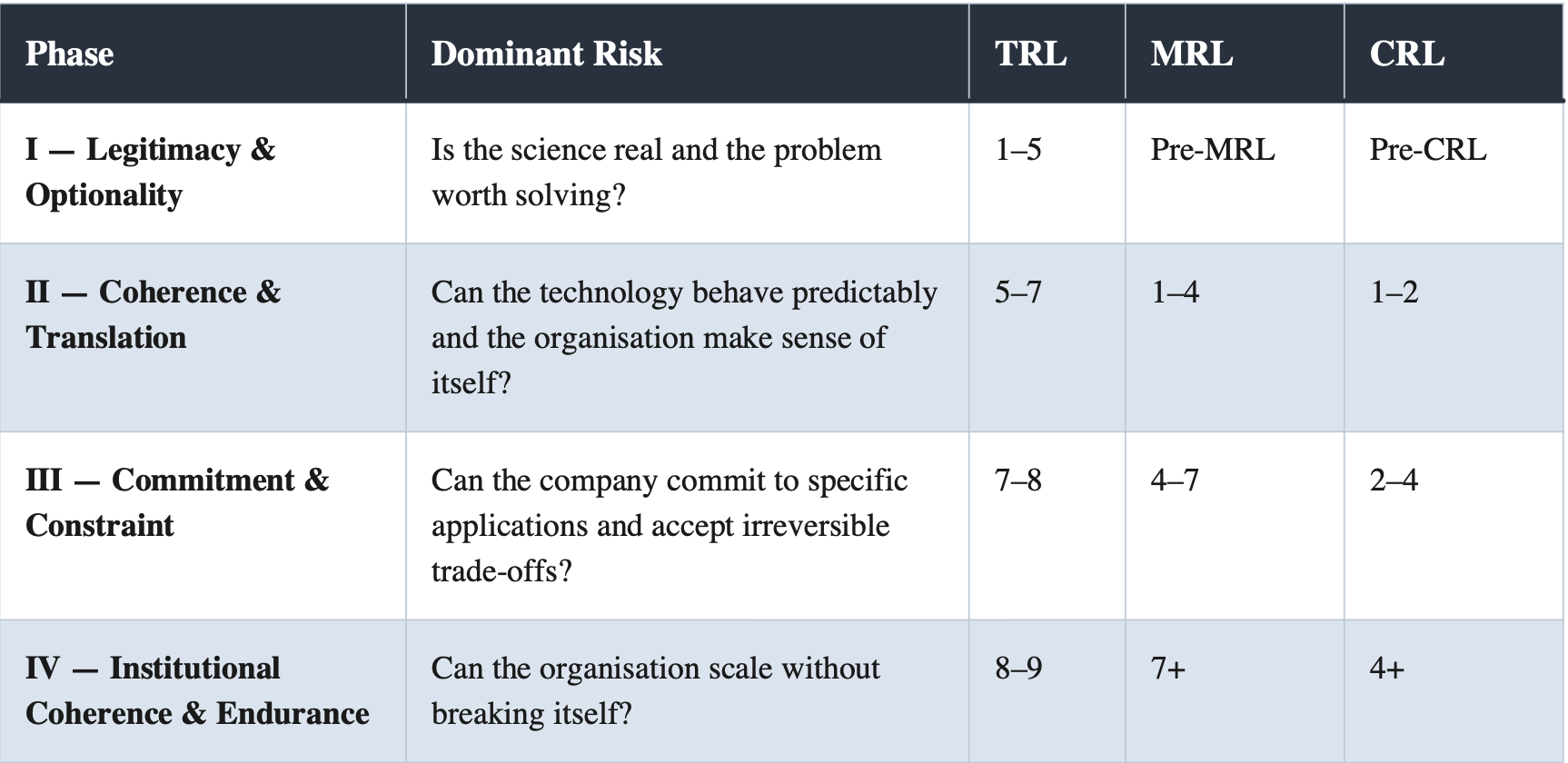
Approximate mapping of the four Lab-to-Market phases onto TRL, MRL, and CRL. Phase transitions are defined by shifts in dominant risk, not by reaching a specific readiness number.
Three Things Worth Remembering
1. Phases are transitions, not gates
A company moves from one phase to the next when the nature of the dominant challenge changes – not when it crosses a threshold. This is why Deep Tech progress can feel non-linear. The same company can be simultaneously advanced on one dimension and dangerously immature on another. A Deep Tech company’s true phase, therefore, is more likely to be determined by the binding constraint, and not the most flattering metric.
2. The phase is defined by its biggest risk
Risk phases are about sequencing. Phase I risks, left unresolved, kill companies early and quietly. Phase II risks, left unresolved, destroy credibility and trigger the kind of investor panic from which no amount of technical progress can recover. Phase III risks produce the most visible failures – companies that appeared mature and well-funded before collapsing on the wrong side of an unrealised commitment. Understanding which risk dominates at any given moment, therefore, becomes the central leadership question.
3. Domain context matters
The timing of phase transitions varies by Deep Tech domain. For example, in Advanced Materials, MRL tends to become the binding constraint sooner than founders expect, pulling companies into Phase III before their TRL would suggest. In Quantum Computing, headline technical metrics have historically outpaced system-level readiness, keeping companies in Phase II far longer than their qubit counts might imply. Knowing your domain's characteristic failure modes makes the framework significantly more useful.
Phase and Leadership
The risk phase framework has a direct implication for leadership – one that we explore throughout the rest of this series. Different phases require different leadership profiles (though not necessarily different leaders).
What makes a founder exceptional in Phase I (scientific credibility, tolerance for ambiguity, speed of learning) can be actively counterproductive in Phase III (where decisiveness, constraint, and commercial judgment matter more). And what makes a Phase III CEO effective can make a Phase IV leader dangerous (where the instinct to solve problems directly conflicts with the need to build scalable systems that solve problems).
Considered through this lens, therefore, key leadership decisions become less about individuals, and more about the reality of the phase / stage in question. Matching leadership capability to phase is one of the most consequential decisions a board can make – and one that, in our experience, is often made too late instead of too early.
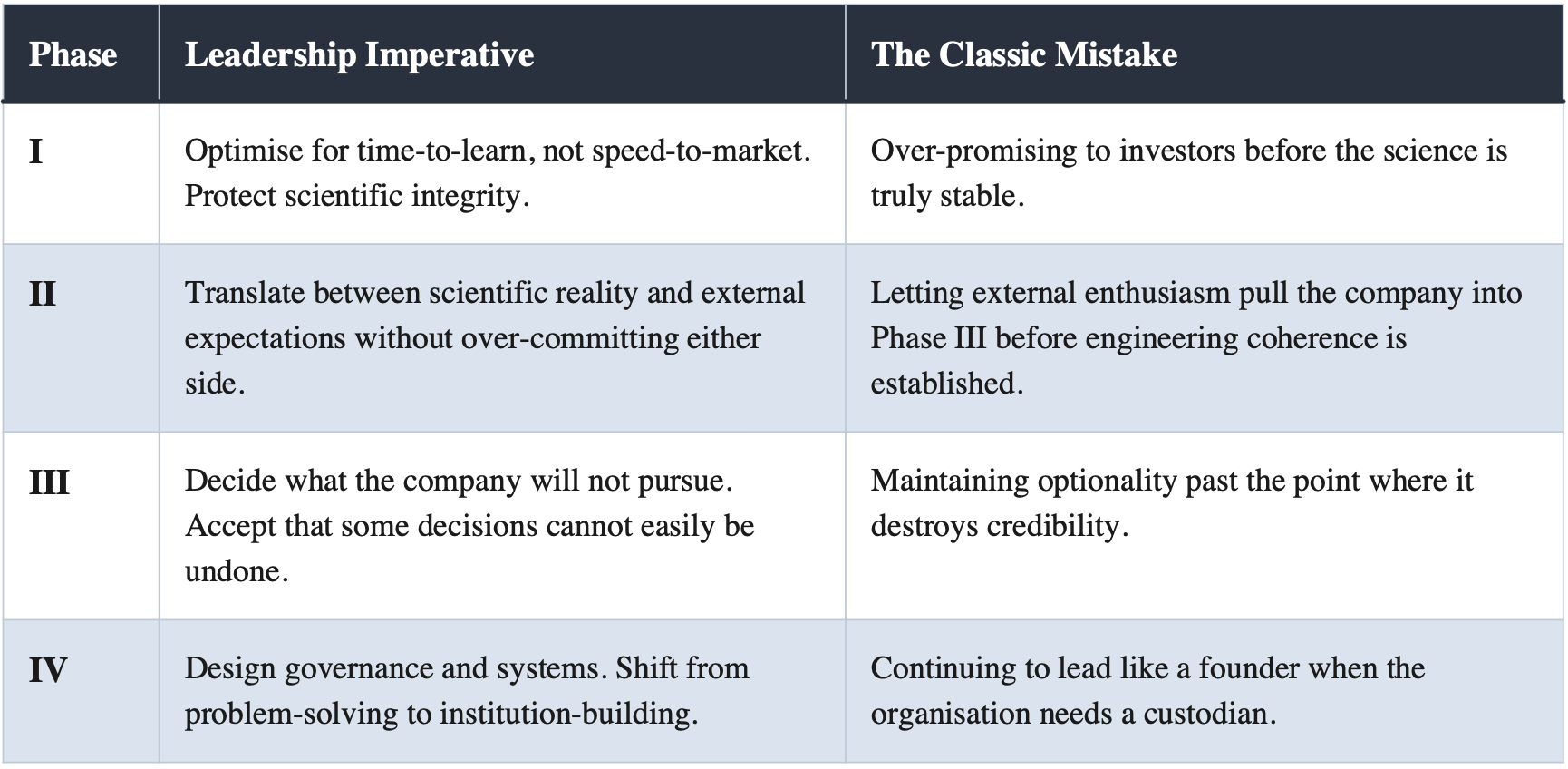
Phase-appropriate leadership imperatives and the most common failure modes at each stage.
Used alongside TRL, MRL, and CRL, the four risk phases offer a more complete picture of where a Deep Tech company actually is, and what it most needs to do next. The readiness frameworks tell you how far along the journey is. Risk phases tell you which risk, if left unresolved, will end it.
That distinction, clearly understood and consistently applied, is what separates Deep Tech companies that effectively navigate the Lab-to-Market journey from those that do not.
Deep Tech Leaders is building the ‘data-first’ operating manual and talent network for companies navigating the Lab-to-Market journey. Through domain-specific data & insight, long-form analysis, in-depth conversations, and our world-leading talent network, we surface how Deep Tech companies actually progress – and why so many fail. This work is underpinned by our executive search practice focused on placing proven leadership talent into roles where phase, risk, and capability align.