Five Founder CEO Archetypes in Deep Tech

Not all Deep Tech founder CEOs are the same. Understanding yours – and aligning them to the risk, phases, and stages of the Lab-to-Market journey – can help your company thrive.
'Should we stick with the founder as CEO?’
How many boards have asked this?
To effectively address this or any question of leadership, boards must understand where on the Lab-to-Market journey they are. Each stage of the journey is distinct, bringing with it particular risks. Being able to clearly define and anticipate these risks is critical when assessing the likelihood of any leader being able to manage through it.
Throughout our work with Deep Tech startups and scaleups, we have observed a number of recurring founder CEO archetypes. None of these is inherently superior, with each carrying distinctive strengths, blind spots, and phase dependencies. Understanding these archetypes, however, can support better decision-making and help avoid painful mistakes.
Why Archetypes Matter
Leadership roles in Lab-to-Market companies are not static positions but a sequence of challenges, each requiring different blends of authority, capability, even restraint. We find it helpful to view these changes in line with the dominant risk facing the company at any one time.
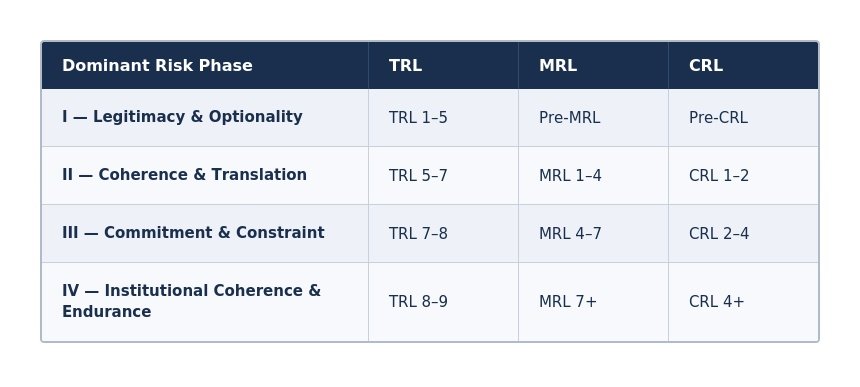
Approximate mapping of the four Lab-to-Market risk phases onto TRL, MRL, and CRL scales. For further reading, see our recent essay, ‘Communicating Progress in Deep Tech, Part 2: The Four Risk Phases’.
Then there are founder CEOs, brilliant individuals who arrive with ingrained orientations that have been shaped by their training, temperament, career history, and identity. Such features often determine how they lead, what risks they prioritise, and where they are most likely to misjudge situations.
We refer to the term ‘archetype’, which should be seen as distinct from personality. Instead, it may be closer to a behavioural pattern, particularly in times of uncertainty. And in Deep Tech, where uncertainty is the defining condition for much of the Lab-to-Market journey, such behavioural patterns can have serious consequences, as we will see.
Below are five of the most common founder CEO archetypes.
The Scientist-Steward
The Scientist-Steward may be the most recognisable Deep Tech founder archetype.
Typically an academic or industrial researcher, this CEO founds the company to pursue a scientific insight they believe the world needs. Their legitimacy is rooted in intellectual authority, while their credibility comes from the depth of their understanding of the problem itself.
In Phase I of the Lab-to-Market journey, the Scientist-Steward is indispensable. The best of them attract elite, phase-relevant, early-stage talent – generally, other scientists and engineers. They excel at holding ambiguity without forcing false clarity and protecting valuable research and discovery time from premature commercial pressure.
No archetype is more aligned with the truth-seeking that the early-stage of Deep Tech (TRL 1-3) demands. But like anyone, they have a blind spot, and a fairly consistent one. Scientist-Stewards often delay organisational decisions – hiring, role definition, authority boundaries – because the company still feels like an extension of a research group. They struggle to translate science into a compelling, accessible narrative. And they often mistime the introduction of commercial or operational discipline.
Transition points for true Scientist-Stewards typically arrive at Phase II or early Phase III, when the dominant risk shifts from scientific plausibility to organisational coherence and external credibility. Some make this transition consciously and effectively, often by partnering with complementary leaders and deliberately redefining their own role. Many others resist it until the board forces a change, at which point the transition is reactive and damaging.
The most successful Scientist-Stewards are those who recognise, early, that protecting the science and building the company are not the same job, and who are willing to separate the two before it is forced upon them.
The Systems Builder
The Systems Builder is an engineer by instinct and identity.
Where the Scientist-Steward is drawn to the problem, the Systems Builder is drawn to the machine, including the physical system and the organisation itself. They think in architectures, interfaces, and feedback loops. They derive energy from making things work reliably.
Systems Builders are often founders who come from applied engineering environments like aerospace, semiconductors, industrial automation, or complex systems integration. They may or may not have originated the core science, but they are drawn to the challenge of turning early, fragile insight into something that survives contact with reality.
In Phases II and III, Systems Builders can be highly effective. They naturally prioritise the risks that kill companies in the middle of the journey: variance, repeatability, process control, and organisational structure. They are comfortable narrowing scope, freezing design decisions, and introducing discipline. They tend to hire for capability rather than pedigree, and they build teams that execute without the need for last-minute heroics.
Their blind spot is twofold. Systems Builders often want to move too quickly toward structure and process, suppressing the early learning the company still needs. They can mistake early prototypes for early products, locking in designs before the solution space is properly understood. At the later stage of the journey, during Phase IV, they often struggle to let go of direct technical involvement, becoming bottlenecks in organisations that may have outgrown their hands-on leadership style.
The most common failure mode of Systems Builders is building a company that works beautifully as a machine and technical organisation, but that struggles to develop an external identity (a narrative, a commercial presence, a reputation) to match its internal capability. The machine runs well, but the world does not yet know what to do with it.
The Visionary Narrator
Visionary Narrators see and articulate a future that does not yet exist.
As founders, they are often the ones who attract disproportionate early capital, media attention, and talent interest. Their gift is conviction.
This archetype can be powerful in Phase I. Capital flows more easily. High-calibre talent takes the leap. Partnerships form on the basis of belief. The company can develop an almost gravitational pull.
The risk, however, is that their narratives can quickly outrun reality. Think of the more toxic choices within Forbes 30-Under-30. Of all the archetypes we have observed, it is the Visionary Narrator that most often lacks the internal locus of control required during the early phases of the Lab-to-Market journey. Such control and discipline are critical for building and maintaining trust with different stakeholders. These types often create implicit promises to investors, partners, and the team itself, that the organisation cannot yet honour. When reality eventually asserts itself, as it usually does, the damage to their credibility can be severe.
The critical failure mode is not always dishonesty, but optimism that becomes deeply embedded. It then skews hiring decisions, commercial commitments, and board expectations in ways that lock the company into timelines and deliverables it cannot meet.
Visionary Narrators who succeed in Deep Tech are those who learn to separate the long-term vision from the near-term operational reality. They surround themselves with leaders who say ‘not yet’. They ultimately accept that credibility in Deep Tech is built through evidence, and that narrative and reality must converge the closer the journey gets to the market.
The Domain Insider
The Domain Insider comes from the industry the company intends to serve.
They may have spent decades inside energy systems, semiconductor supply chains, industrial manufacturing, or defence. They understand the customer’s world intimately, including its decision structures, risk tolerances, qualification processes, and political dynamics.
This archetype is less common as a sole founder, instead appearing frequently as a co-founder or early, externally appointed CEO, particularly in Climate Hardware, Advanced Materials, and Semiconductors where adoption is governed by long qualification cycles and conservative buyers.
The Domain Insider’s strength is readiness awareness. They know what ‘good’ or ‘ready’ actually means to the ecosystem in terms of technical benchmarks, and also in terms of trust, compliance, and integration. They tend to be realistic about timelines and almost paranoid about over-commitment. These types are also strong at navigating complex stakeholder relationships that determine whether their complex solutions get adopted.
The blind spot is that Domain Insiders can under-invest in early-stage exploration. Their instinct is to move toward the market they understand, which can narrow the solution space prematurely. They can struggle to give technical teams the freedom to fail and iterate because their mental model of progress is too focused on the industry’s expectations, rather than the natural pace of technology development.
The failure mode is a company that is commercially well-positioned but technically under-developed, often one that arrives at customer conversations before the product can support them. In Advanced Materials, this manifests as qualification attempts with immature processes. In Semiconductors, it appears as design-in conversations with chips not yet manufacturable at acceptable yield. At its most concerning, a Domain Insider’s credibility with external stakeholders can actually accelerate the company into commitments it cannot honour.
The Repeat Founder
Finally, we have the Repeat Founder, an executive with previous Lab-to-Market experience.
They arrive with pattern recognition, investor relationships, recruiting networks, and a visceral understanding of what it feels like when things are going wrong.
Repeat founders are often exceptionally effective in Phases II and III. They anticipate the organisational growing pains that first-time founders often fail to fully grasp. They hire faster, structure earlier, and manage boards with more confidence. They tend to be better at the unglamorous work of company-building: governance, role design, capital structuring, and stakeholder management.
The risk for Repeat Founders is pattern over-matching. Deep Tech domains vary enormously, and the lessons of a previous venture, particularly one in a different sector or at a different level of scientific depth, may not transfer cleanly. A founder who scaled a software-adjacent hardware company may underestimate the manufacturing complexity of a new materials venture. A founder whose previous company succeeded through speed may struggle in a domain where patience is the priority.
The failure mode here may be premature professionalisation. Repeat Founders often import structures, processes, and leadership models from later-stage companies too early, believing that operational maturity will accelerate progress. In Deep Tech, this can suppress the early learning the company still needs. The organisation starts behaving like a scale-up before it has earned the right to be one.
The best Repeat Founders we have seen are those who recognise that familiarity with the shape of the journey does not guarantee understanding of the specific terrain. They tend to treat their experience as a source of questions rather than answers.
Why Archetypes Collide and Why That Can Be Productive
Many Deep Tech companies are co-founded by leaders whose archetypes are complementary – a Scientist-Steward and a Systems Builder, for instance, or a Visionary Narrator paired with a Domain Insider. Such pairings can be highly effective. They distribute risk awareness across the leadership team. They also create healthy, productive tension between exploration and execution, ambition and discipline.
But they can also be destructive. When the company is under pressure – think of fundraising, pilot failures, or scaling challenges – these tensions can harden into political divisions. The Scientist-Steward perceives the Systems Builder as stifling innovation. The Visionary Narrator perceives the Domain Insider as overly cautious. Each founder believes the company’s survival depends on their instinct prevailing.
The companies that navigate these dynamics well do so by alighting on a common way of communicating and measuring progress. When founders and boards understand the archetype each leader represents, and which phase of risk that archetype is optimised for, the conflict becomes diagnostic rather than personal or political. The question shifts from ‘Who is right?’ to ‘Which risk are we actually trying to resolve right now, and whose instincts are best aligned with that?’
Domain Variations
While the archetypes are consistent, their distribution and phase-alignment vary significantly by domain.
Advanced Materials companies are almost always founded by Scientist-Stewards, and the transition challenge there is particularly acute. Manufacturing readiness – not further science – tends to become the binding constraint sooner than founders expect, which makes Domain Insiders with process engineering or industrial supply chain backgrounds critical complements rather than later additions.
Climate Hardware attracts Visionary Narrators in disproportionate numbers, drawn by the urgency and public visibility of the sector. The risk of narrative outrunning reality is correspondingly pronounced. Early Domain Insider involvement tends to be particularly valuable here, given how early deployment economics, finance structures, and regulatory pathways assert themselves as real constraints.
The Systems Builder tends to be the most phase-durable archetype in Semiconductors, for the straightforward reason that the journey is dominated by engineering execution, foundry navigation, and ecosystem alignment from relatively early on. Scientist-Steward founders in this domain face an earlier and more demanding transition than in most other sectors.
Quantum Computing is Scientist-Steward territory, reflecting the field’s proximity to fundamental physics. The transition to systems engineering leadership is one of the most consequential inflection points in the domain – and, in our experience, one of the most frequently deferred.
Robotics is the exception to most of the above patterns. Archetypes are more evenly distributed, reflecting the inherently multi-disciplinary nature of the field. The risk is less that any single archetype dominates and more that any single orientation – hardware, software, or commercial – comes to dominate at the expense of the others.
What This Changes for Boards and Investors
The ‘archetype lens’ gives boards a neutral language for discussing leadership evolution – one that makes it possible to ask whether the CEO’s natural orientation still matches the dominant risk, without framing the conversation as a performance review. It helps distinguish between a founder who is genuinely misaligned with the current phase and one who simply needs support, complementary leadership, or a redefined role.
Investors gain something equally useful: an earlier signal of potential misalignment. A Scientist-Steward CEO leading a company into Phase III without operational or commercial leadership support is a predictable stall point. A Visionary Narrator whose narrative has not been stress-tested against manufacturing reality is an emerging credibility risk. Both are visible well before financial metrics deteriorate or milestones begin to slip.
Perhaps the more personal value is for founders themselves. The framework offers a way to see one’s own pattern without shame – to recognise that the instincts that made the company possible may not be the instincts that will make it scale, and that this is not a failure. It is a mark of the kind of self-awareness that separates founders who endure from those who are eventually replaced.
The Archetype Is Not the Destiny
People evolve. The best founders evolve deliberately. A Scientist-Steward who builds genuine operational judgement can lead far longer than the archetype might suggest. A Visionary Narrator who learns to discipline their storytelling with evidence can retain credibility through the most demanding phases of the journey. One can also take on qualities of the other. How many times have we seen inspiring Scientist-Stewards transition into Visionary Narrators?
What does not work, however, is pretending that the archetype does not matter – that leadership in Deep Tech is generic, that any sufficiently intelligent person can lead any phase, or that founding status alone confers enduring authority.
The Lab-to-Market journey is unforgiving precisely because the risks change faster than most leaders adapt. From what we have seen over the years, companies that survive are those that understand the archetype they have, the phase they are in, and the gap between the two. From that understanding, everything else follows: complementary hiring, role redesign, governance evolution, and – when necessary – transitions that preserve what the founder has worked so hard to build.
Appreciating the different founder CEO archetypes is therefore a practical leadership discipline, and, for many Deep Tech companies, a survival skill.
Used alongside TRL, MRL, and CRL, the four risk phases offer a more complete picture of where a Deep Tech company actually is, and what it most needs to do next. The readiness frameworks tell you how far along the journey is. Risk phases tell you which risk, if left unresolved, will end it.
That distinction, clearly understood and consistently applied, is what separates Deep Tech companies that effectively navigate the Lab-to-Market journey from those that do not.
Deep Tech Leaders is building the ‘data-first’ operating manual and talent network for companies navigating the Lab-to-Market journey. Through domain-specific data & insight, long-form analysis, in-depth conversations, and our world-leading talent network, we surface how Deep Tech companies actually progress – and why so many fail. This work is underpinned by our executive search practice focused on placing proven leadership talent into roles where phase, risk, and capability align.